
Category: United States of America
Visit to Mt. Soledad
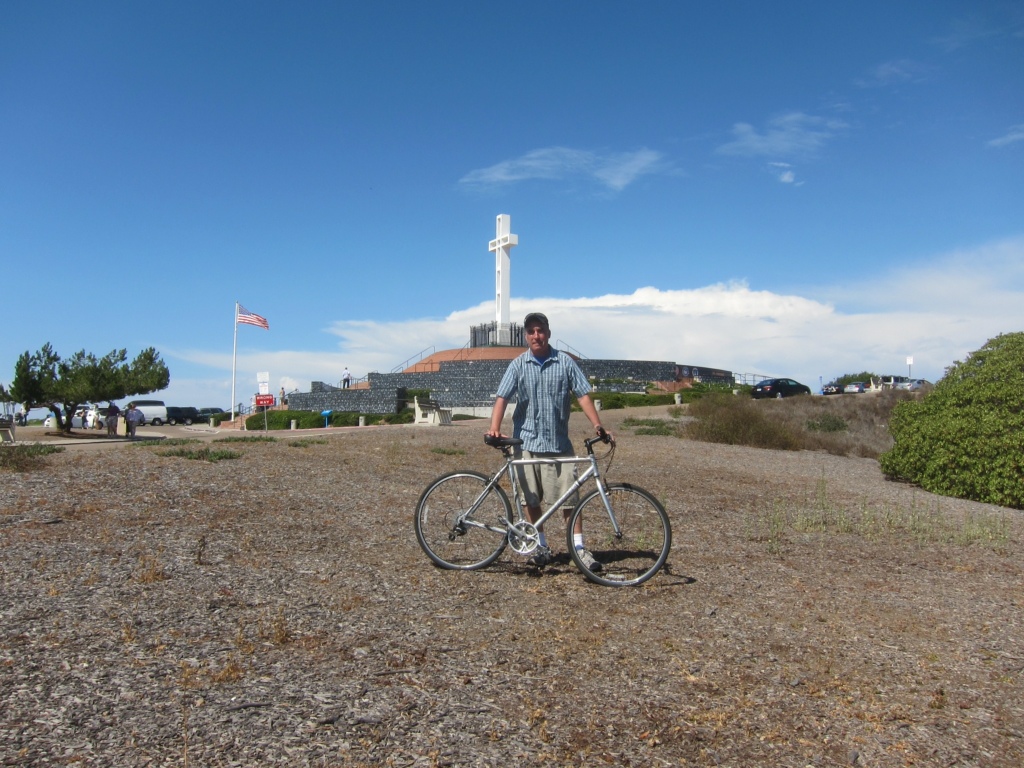
I biked to the top of Mt. Soledad in La Jolla on July 4th. Mount Soledad’s summit is at height of 822 ft and biking up or hiking up to the top is a serious physical challenge. I had not done any serious biking in a while and I had to walk up a few steep sections of the route up from the Pacific Beach side of the mountain, but the 360 degree views of the San Diego area and the Pacific Ocean were well worth the effort, as was the opportunity to see the historic National Veterans Memorial again. I highly recommend a visit to Mt. Soledad for those of with plans to visit San Diego. Of course, you don’t have to hike or bike up there if you don’t want to. Driving up to the summit is a bit easier and there is ample parking near the memorial.

Visit to Fort Rosecrans National Cemetery
 This past Friday I visited Fort Rosecrans National Cemetery for the first time. I’ve lived in San Diego for over 10 years, but I had never before walked the grounds of this historic place. With Memorial Day approaching it seemed like an appropriate time to finally visit.
The cemetery is located high above the Pacific Ocean on the southern end of Point Loma in San Diego. It was established in 1882 and there are over 100,000 graves on the grounds of the 77 acre military cemetery.
Fort Rosecrans is a very solemn place, but also a beautiful place and a fitting resting place for some of our nation’s military heroes.
If you would like to learn more about Fort Rosecrans National Cemetery please see the Wikipedia entry on the link below:
http://en.wikipedia.org/wiki/Fort_Rosecrans_National_Cemetery





Breaking The UniParty | Online Library of Law and Liberty
Breaking The UniParty | Online Library of Law and Liberty.
This is an excellent article by Angelo M. Codevilla, Professor of International Relations at Boston University. As the title of this piece suggests, the country is now run by what seems to be one party. It is a party that represents big government and one that excludes those with conservative and libertarian beliefs.
74% Rarely or Never Use Mass Transit – Rasmussen Reports™
74% Rarely or Never Use Mass Transit – Rasmussen Reports™.
I am going to come back to this post and add some add comments about this topic. I was a little surprised that so many people in this country never use mass transit. I think more people will use mass transit in the future, but the figures in this report indicate that a lot of work remains to be done to get more people on mass transit.
Rand Paul: ‘Old guard’ losing elections – James Arkin – POLITICO.com
Rand Paul: ‘Old guard’ losing elections – James Arkin – POLITICO.com.
I think Rand Paul is absolutely correct about the GOP’s “Old Guard” and I think Paul will prove to be a very formidable candidate for President in 2016. I look forward to Paul engaging in an ideological battle with the representatives of the Old Guard (Chris Christie, Jeb Bush, John McCain, Peter King, et al).
Obama vs. Romney: An election that is too close to call?
Is this election really too close to call? Not if you listen to many pundits, prognosticators and political analysts in the media these days. They all think it is going to be a blowout. The problem is many think it will be Obama winning by a landslide and many others thinking it will Romney winning by a landslide. I can’t remember a major election where opinion was so divided so close to the election. A lot of people who have called this race are going “All In”, one way or another that declaring that either Obama or Romney will win easily.
Those calling for a decisive Obama victory include Nate Silver, author of The New York Times 538 political blog, former Dem campaign manager Bob Shrum, CNBC’s Jim Cramer .
Those calling for a Romney blowout include former campaign manager Dick Morris, talk show host Rush Limbaugh, political analyst Michael Barrone and two Political Science professors (Kenneth Bickers and Michael Berry) from the University of Colorado.
I am particularly interested to see how the professors do. Their election forecasting model, which uses economic data from each state to predict how each state will vote (good econ data favors the incumbent and vice versa), has correctly picked presidential winners, both Republican and Democrat, since 1980.
Obviously, all these people can’t be right.
I think one of the following three scenarios will unfold:
1) Obama wins by a narrow margin. Obama holds all the traditional Blue states and takes just enough of the Swing states to put him over the 276 electoral votes he needs to win.
2) Romney wins by a narrow margin. Romney wins the Red states he needs, plus most of the Swing states and one or two Blue states that were considered safe for the Democrats.
3) Romney wins by a landslide. Romney runs the table on the Swing states and takes a number of other big states that would normally be considered safe for Democrats, such as PA, MN and OR.
I am indeed a little biased, I will admit that I want Romney to win and of the three scenario’s I outlined above I think #2 is most likely, although I will gladly take #3 also. However, will I be shocked if Obama wins? Not at all. If Obama wins by a landslide, with 300 plus electoral votes I will be very surprised because I just think he is going to lose too many independents this time around to make a landslide for him possible. However, Obama is the incumbent and that makes him difficult to defeat, even though his first term has not met the expectations of even many of his supporters. The vast majority of the main stream media have been pro-Obama/ anti-Romney and that gives Obama a significant edge. Without the support of MSM Obama would no chance in my opinion, but he does have it and that give him a big advantage.
POST ELECTION REVIEW
Barack Obama 303 Electoral Votes* 60,788,910 Popular Votes
Mitt Romney 206 Electoral Votes 57,894,038 Popular Votes
*Not including Florida (EV’s for Florida still being determined).
Well, I was obviously wrong about the outcome of the presidential race, although in my defense I would point out that I did think that there was a distinct possibly that Obama could win (see my post above).
I did not think Obama would win by a landslide, but he did win over 300 electoral votes, which can reasonably be called a landslide. However, Romney fared much better in the popular vote count, losing by only 3 million votes. That relatively small difference is frustrating. This race was winnable for Romney in my opinion. Romney lost a few states by very small margins, such as Ohio (lost by 1.9%) or Virgina (lost by 3.0%). A few other states were lost by 6 percent or less.
I haven’t come to totally firm conclusions about Obama’s victory because I’m still looking at voting data and reading post election postmortems from a variety of different sources. However, my initial reaction to the race’s outcome would include the following:
In retrospect, I think Romney should have more aggressively attacked Obama’s positions on major issues and his qualifications. Romney and his team seemed to rely too much attacking on the poor performance of the economy during Obama’s 1st term.
I also think Romney’s campaign was too slow to respond to some Obama campaign’s attacks on Romney and when they did the defense was often less then vigorous (Such as the attacks on Romney’s former company Bain Capital).
Unfortunately, I think Obama’s campaign team was more aggressive and effective. I can’t say I admire them, but they obviously figured out how exploit Romney’s weak points and craft a strategy that delivered the states they needed to win.
In Nothing We Trust – Ron Fournier and Sophie Quinton – NationalJournal.com
Obama, Romney and the Pathways to 270
Obama, Romney and the Pathways to 270.
The link above is to a Real Clear Politics article which explains the challenges that face both President Obama and Mitt Romney in attempting to capture the 270 electoral votes required to win the presidential election in November. The race will probably be decided by who wins a majority of the following “swing” states:
Colorado, Florida, Iowa, Michigan, Nevada, New Hampshire, New Mexico, North Carolina, Ohio, Pennsylvania, Virginia and Wisconsin.
Excerpt from the RCP article:
When potential electoral values are assigned to the two opposing camps, both sides look to John Kerry’s wins on the 2004 map as a base line for President Obama — and John McCain’s victories in 2008 as a starting point for Mitt Romney. In the minds of the political class, these focal points will always indicate an uphill climb for the challenger.
That is because assuming Obama wins the 19 states (and the District of Columbia) that Kerry did, he will net 246 electoral votes. (That’s five fewer than the 251 those states yielded in 2004, thanks to reallocation following the 2010 census.) McCain notched just 173 electoral votes in 2008. Fast-forward to this year, and the states McCain won translate to 180, which Republican officials assume will all be in the bag for Romney.
 gmf journal